 Take the First Step
Introduction: The Phrase Every Parent Hears — But Few Can Verify
Walk into any childcare centre in Singapore and you will almost certainly see it: “holistic preschool or curriculum.” It appears on brochures, websites, open house banners, and admissions checklists. But what does it actually mean — and more importantly, how do you know when it is real?
This guide is written by the educators at Ilham Child Care, a Singapore childcare centre recognised as the Best Holistic preschool and Childcare Provider 2024 by APAC Insider. We have been delivering genuine holistic, inclusive education since 2013 — and our goal here is to give parents a clear, honest framework for evaluating any childcare centre, including us.
By the end of this article, you will know exactly which questions to ask, what to observe during a centre visit, and which red flags to walk away from.
What “Holistic Curriculum” Actually Means in Early Childhood Education
In early childhood education (ECE), a holistic curriculum addresses the whole child — not just academic readiness. According to the Singapore Early Childhood Development Agency (ECDA) framework, a holistic approach nurtures five developmental domains:
- Cognitive development — problem-solving, curiosity, early literacy and numeracy
- Language and communication — verbal expression, listening, bilingual and multilingual foundations
- Social and emotional development — empathy, self-regulation, relationship-building
- Aesthetic and creative expression — art, music, movement, imaginative play
- Motor development — fine motor skills (drawing, cutting) and gross motor (climbing, running)
A genuine holistic preschool curriculum in Singapore intentionally plans learning experiences across all five domains every single day. It is not a rotating “art session on Fridays” or a once-a-week music class bolted onto an otherwise academic programme.
At Ilham Child Care, holistic development is woven into everything — including spiritual nourishment through Islamic values, four-language learning (English, Malay, Mandarin, and Arabic), and nine complimentary enrichment programmes that are fully included in our one fee, with no extras charged to families.
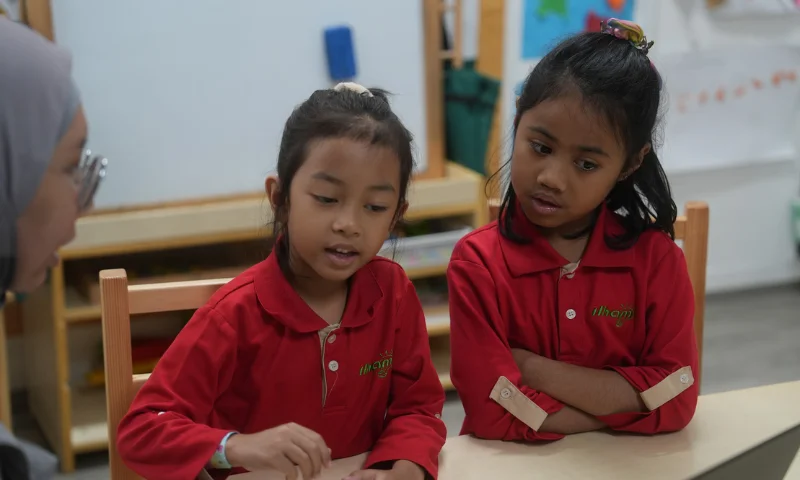
5 Signs a Holistic Curriculum Is Genuine
1. Teachers Can Explain the “Why” Behind Every Activity
This is the single most reliable indicator. Ask any teacher at the centre: “What are the children learning from this activity?”
A teacher in a genuinely holistic childcare centre will give you a multi-domain answer without hesitation. For example: “We are building sequencing skills, encouraging collaborative negotiation, and practising fine motor grip — all through this block-building game.”
A teacher delivering a curriculum that is holistic in name only will give you a single-domain or vague answer: “They are learning to share” or “It is a STEM activity.” At Ilham Child Care, our educators are trained to plan and articulate across all developmental domains — because when you meet our teachers, we want you to hear exactly that level of intentionality.
2. The Physical Environment Reflects Multiple Learning Modes
Walk slowly through the classroom before you sit down with the principal. In a genuinely holistic environment, you will observe:
- A reading corner with books in English, Malay, Mandarin, and Arabic at child height
- A construction or block area for spatial reasoning and engineering thinking
- A sensory or science exploration table for curiosity and scientific inquiry
- An art corner with open-ended materials — not just colouring sheets
- A dramatic play or role-play area for social skills, language, and emotional development
If the classroom is mostly desks in rows with workbooks, the curriculum is academic-focused — not holistic. Ilham Child Care’s Montessori-inspired classrooms for our youngest Ilhamites (18 months to 3 years) are specifically designed for child-initiated discovery across all domains.
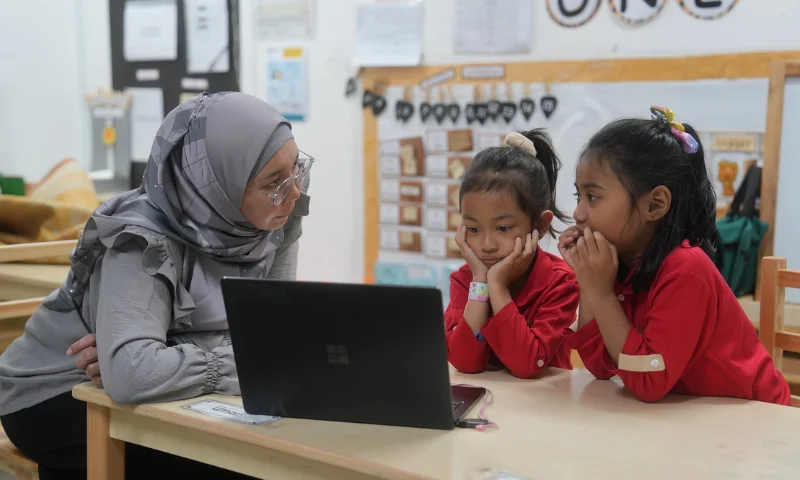
3. Assessments Track Development, Not Just Academic Output
How does the centre measure progress? A genuine holistic programme uses portfolio-based documentation — photographs, observations, and samples of children’s work compiled over time. Teachers write developmental narratives, not just test scores. Parents receive updates that address social skills, emotional regulation, creativity, and spiritual growth alongside early literacy.
If a childcare centre’s end-of-term report focuses primarily on whether your child can write their name or count to 20, the curriculum is skewed toward academic readiness, not whole-child development.
4. Children With Diverse Needs Are Included, Not Separated
Inclusive early childhood education is a hallmark of genuine holistic practice. A curriculum that claims to nurture the whole child but excludes children with special needs is — by definition — not holistic.
At Ilham Child Care, we believe every child should receive equal learning opportunities regardless of their family’s financial background or their child’s learning profile. Children with and without additional needs learn alongside each other in the same classroom. This reflects not just best practice in developmental science — it reflects our deepest values as a community. Our #YourChildNeverWalksAlone programme ensures that no family is left behind — financially, educationally, or socially
5. Outdoor and Physical Play Is Structured Into the Daily Schedule
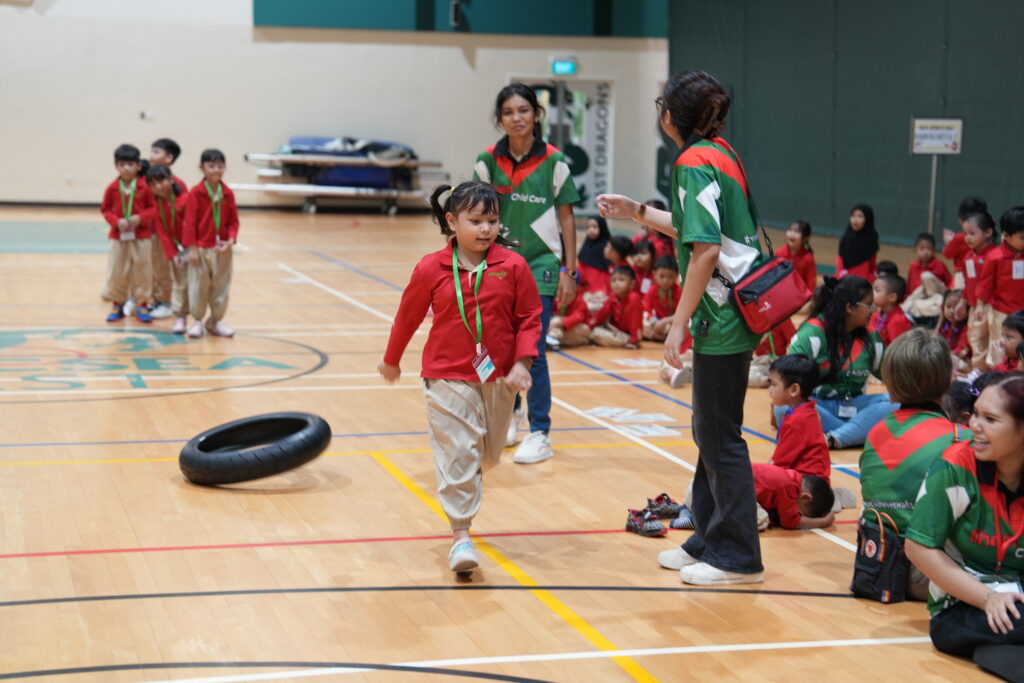
Gross motor development and outdoor play are not extras — they are fundamental to holistic early childhood education. Ask to see the daily timetable. If outdoor time is listed as “weather permitting” or consistently bumped for worksheet time, it is a sign the centre prioritises academic outcomes over whole-child development.
At Ilham, physical development is built into every day — through our outdoor play sessions and our Martial Arts enrichment programme (in partnership with Kali Majapahit), included at no extra cost for all Ilhamites.
5 Red Flags That Suggest a Curriculum Is More Marketing Than Reality
- The brochure uses “holistic” but the syllabus lists only literacy and numeracy benchmarks.
- Open house tours skip the classroom entirely — you only see the reception area and a slide deck.
- Staff cannot describe their teaching philosophy in their own words — they defer to printed materials.
- There is no mention of social-emotional learning (SEL), spiritual development, or values education.
- The centre cannot explain how children with different learning styles or special needs are supported.
Parents asking about enrichment classes for preschoolers should also be aware: a separate enrichment schedule charged on top of an otherwise narrow curriculum does not make that curriculum holistic. At Ilham Child Care, all nine enrichment programmes — from Jolly Phonics to Speech & Drama to Cookery (including Sunnah food) — are included in one transparent fee.
Questions to Ask on Your Centre Visit
Use this checklist during any preschool or childcare centre visit in Singapore. These questions are designed to surface genuine practice — not rehearsed marketing answers.
- “Can you show me a sample week’s programme and walk me through how it addresses each developmental domain?”
- “How do you support children who are finding something difficult — socially, academically, or emotionally?”
- “How do you communicate a child’s developmental progress to parents beyond report cards?”
- “What does your outdoor or physical education time look like on a typical day?”
- “Do you have children with special needs enrolled? How are they supported in the classroom?”
- “What professional development do teachers undertake in early childhood education?”
- “Are enrichment programmes included in the fee, or charged separately?”
At Ilham Child Care, we welcome every one of these questions. We are confident our curriculum — and our educators — stand up to scrutiny.
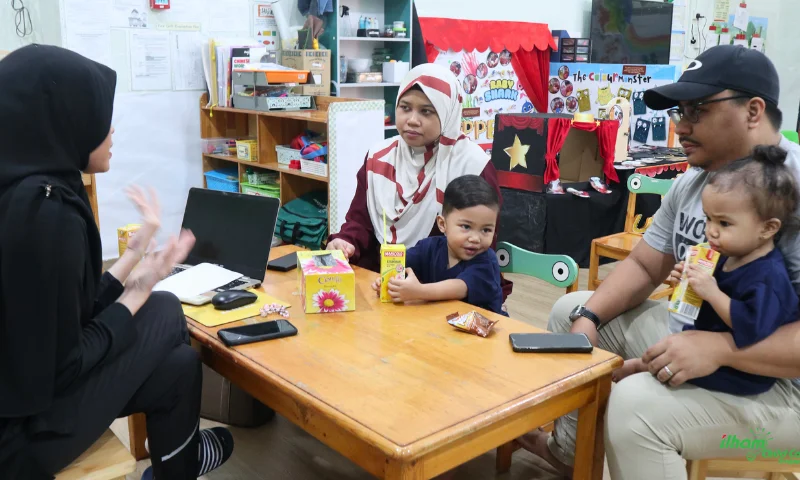
Why This Matters for Infant Care and Long-Term Development
The early years — from birth to six — are widely recognised by developmental science as the most critical period for brain architecture. What happens in infant care and preschool does not just prepare children for primary school registration; it shapes how they learn, relate to others, regulate emotion, and form their character for the rest of their lives.
At Ilham Child Care, we believe this development is inseparable from the values and community in which a child grows. That is why our holistic curriculum includes spiritual nourishment — the gentle introduction of Islamic values, Arabic language, dua, and surahs — as a core developmental domain, not an optional add-on.
About Ilham Child Care: Our Approach to Holistic Early Childhood Education
Ilham Child Care is a Singapore childcare centre offering infant care, playgroup, nursery, kindergarten, and student care programmes rooted in inclusive, play-based, and holistic pedagogy — with Islamic values woven throughout. We have been recognised as the Best Holistic Childcare Provider 2024 in Singapore by APAC Insider.
Our educators hold qualifications in early childhood education and participate in ongoing professional development aligned with Singapore’s ECDA framework. Our nine complimentary enrichment programmes — Jolly Phonics, Montessori, Messy Play, Show & Tell, Speech & Drama, Martial Arts, Cookery, Malay Immersion, and Digital Literacy — are included for all Ilhamites at no extra cost.
We have three locations across Singapore, making quality holistic childcare accessible close to home or your workplace. We believe transparency is the foundation of trust, and we invite every family to visit our classrooms, speak with our teachers, and ask the hard questions.
Ready to See the Difference for Yourself?
Book a visit to Ilham Child Care and experience our holistic learning environment first-hand.
• Speak directly with our educators — not just our admin team
• Tour our inclusive classrooms across our 3 Singapore locations
• Get honest answers to every question on your list
→ Visit: www.ilhamchildcare.com | Call or WhatsApp to schedule your tour → Infant care, playgroup, nursery, K1–K2, and student care — #YourChildNeverWalksAlone