 Take the First Step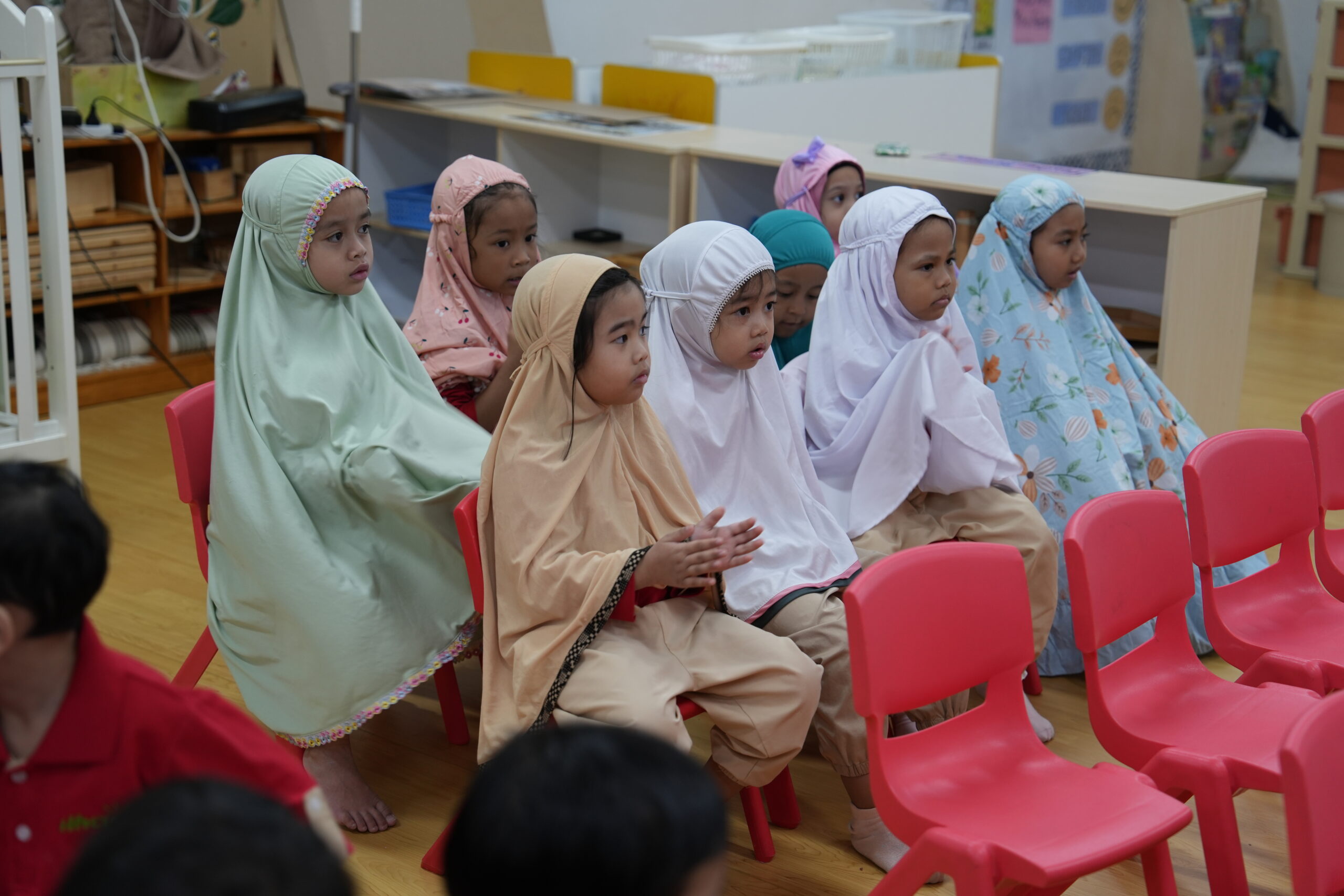
For Muslim parents in Singapore, choosing a childcare centre or preschool involves a question that goes beyond curriculum and facilities: will my child’s Islamic identity be nurtured alongside their academic development?
The answer — and the quality of that answer — varies enormously between centres. But a growing body of research, combined with the guidance of Singapore’s own religious and educational authorities, points to a clear conclusion: the early years are the single most important window for establishing a child’s spiritual identity, moral values, and language foundations in their deen.
This guide explains what genuine Islamic early childhood education looks like, what Singapore’s MUIS certification means, what you should expect from a quality Islamic preschool, and why families who understand this choose Ilham Childcare.
What Is Islamic Early Childhood Education?
Islamic early childhood education (ECE) is not simply a standard preschool curriculum with Islamic studies added as an elective. At its most meaningful, it is an integrated approach to the whole child’s development — cognitive, physical, social-emotional, and spiritual — grounded in Islamic values and guided by the principles of tarbiyah (upbringing and nurturing).
The concept of tarbiyah encompasses more than knowledge transmission. It refers to the holistic cultivation of the child’s fitrah — their innate, God-given disposition toward good, truth, and purpose. Islamic scholars from al-Ghazali to Ibn Khaldun consistently emphasised that the earliest years of life are when the heart and mind are most impressionable, and most receptive to the planting of righteous values.
In practical terms, Islamic ECE integrates:
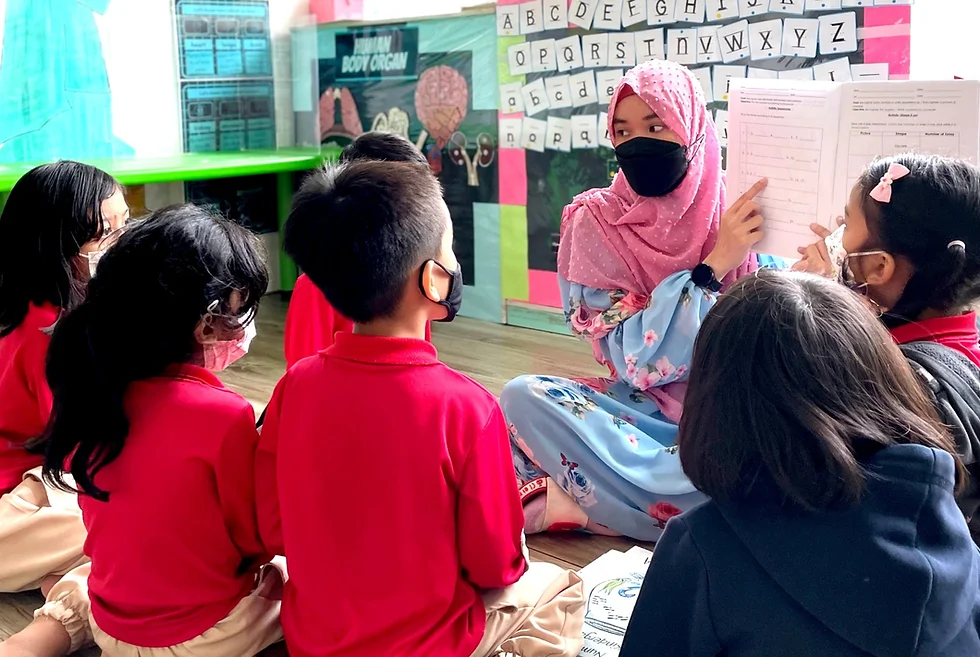
- Arabic language learning — beginning with huruf hijaiyyah (Arabic alphabet), progressing to vocabulary, sentence recognition, and phonological awareness in the language of the Quran
- Quranic foundations — memorisation of short surahs, duas (supplications), and basic understanding of their meanings
- Islamic character education — practising honesty, gratitude, compassion, respect for elders, and responsibility, embedded in daily routines
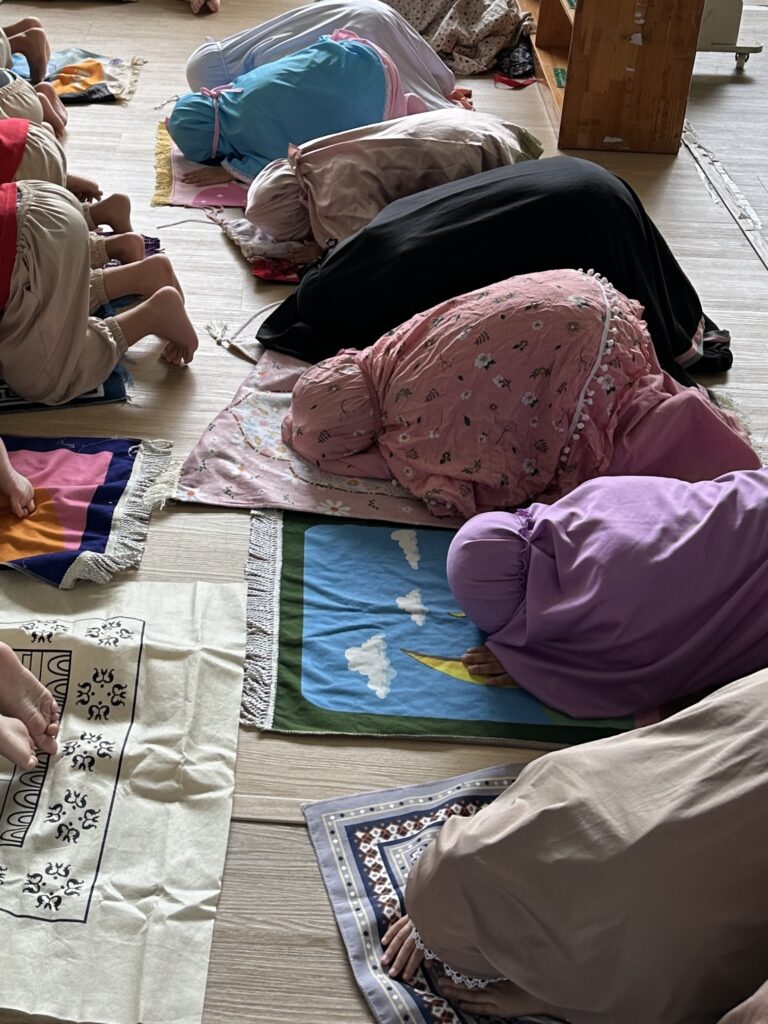
- Islamic daily practices — learning the five pillars, prayer positions, greetings (As-salamu alaykum), and Islamic etiquette (adab)
- Culturally integrated learning — Malay language and cultural context, celebrations of Islamic occasions such as Eid, and knowledge of the Prophet’s life (seerah) in age-appropriate form
Why the Early Years Are the Most Important Time for Islamic Upbringing
The Science Aligns with Islamic Tradition
Modern developmental neuroscience confirms what Islamic scholarship has long asserted: the years from birth to age 6 are when the human brain is most plastic, most receptive to new learning, and most significantly shaped by environment.
Harvard University’s Center on the Developing Child describes this period as the most important in human development, characterised by the formation of 1 million neural connections per second. The values, language patterns, emotional responses, and habits of mind formed in these years become the default architecture of the child’s future self.
This aligns directly with the Hadith of the Prophet Muhammad (peace be upon him): ‘Every child is born in a state of fitrah (natural disposition). It is their parents who make them a Jew, a Christian, or a Zoroastrian.’ The hadith speaks to parental and environmental influence during the earliest years — precisely what neuroscience now confirms as the period of maximum neural sensitivity. Imam al-Ghazali, in Ihya Ulum al-Din, wrote that ‘the child is a trust in the hands of his parents… and teaching it good is the obligation of both the father and teacher.’ He specifically noted that the younger the child, the more permanent the impressions made upon them — a 9th-century insight now confirmed by modern developmental science
Language Acquisition: The Critical Window for Arabic
Psycholinguistic research consistently shows that the optimal window for acquiring phonological sensitivity in any language — including Arabic — runs from birth through approximately age 7. Children who receive structured exposure to Arabic during this period develop neural pathways that make later Quranic recitation, comprehension, and memorisation significantly easier. Research by Kuhl et al. (2005) in Science demonstrated that early phonological exposure permanently shapes which sound distinctions the brain can easily perceive and reproduce. Arabic possesses several phonemes not found in English, Malay, or Mandarin — sounds like ‘ain (ع), ghayn (غ), and the emphatic consonants (ص ,ض ,ط ,ظ). Exposure in early childhood enables children to hear and produce these sounds with native-like accuracy
MUIS and the Islamic Education Childcare Programme (IECP)
In Singapore, the Majlis Ugama Islam Singapura (MUIS) — the Islamic Religious Council of Singapore — has developed a formal framework for Islamic education in childcare and preschool settings: the Islamic Education Childcare Programme (IECP).
IECP certification is not automatic. Centres must meet defined standards across curriculum content, teacher qualification, and programme delivery. Key requirements include:
- A structured Islamic studies curriculum covering Arabic literacy, Islamic values, and religious practices appropriate to each age group
- Qualified ustaz/ustazah (Islamic teachers) or educators who have completed recognised Islamic studies training
- Integration of Islamic teachings across the school day, not merely in isolated ‘Islamic studies’ lessons
- Regular quality reviews and compliance checks by MUIS
For Muslim parents, MUIS IECP certification is the most reliable indicator that a childcare centre’s Islamic education has been independently verified against a national standard — rather than being marketing language without substance.
All Ilham Childcare centres are MUIS IECP certified. This means every child in Ilham’s care receives Islamic education that has been reviewed and approved by Singapore’s highest Islamic authority.
What Islamic ECE Looks Like in Practice at Ilham Childcare
Arabic and Quranic Foundations
From Playgroup (18 months) onwards, Ilham children are introduced to huruf hijaiyyah — the Arabic alphabet — using multisensory techniques that make letter recognition engaging rather than rote. As children progress through Nursery 1, Nursery 2, and Kindergarten, Arabic vocabulary expands systematically. By Kindergarten 2, children are able to read simple Arabic texts, recite key surahs with correct pronunciation, and understand the basic meaning of the duas they recite daily.
This is not incidental exposure — it is a sequenced curriculum designed to build genuine Arabic literacy year by year.
Daily Islamic Practice: Embedded, Not Bolted On
At Ilham, Islamic practices are woven into the fabric of the school day rather than treated as a separate subject. Children learn and recite bismillah before meals, practise dua for entering and leaving the classroom, observe Islamic greetings, and develop awareness of the times of prayer. Fasts of Ramadan are explained and honoured. Stories of the prophets and companions are shared in age-appropriate ways that build love for Islamic history.
This embedded approach is backed by research on values formation. Studies in moral development (Berkowitz and Bier, 2005; Character Education Partnership) show that values are most effectively internalised when modelled consistently in daily interactions — not when taught as a separate class.
The Madrasah Preparatory Programme
One of the most significant practical offerings at Ilham — and a key reason Muslim families in Singapore choose the centre — is the Madrasah Preparatory Programme, available from Nursery 2 onwards.
Gaining entry to a Madrasah in Singapore is competitive. The entrance examination tests Arabic literacy, surah memorisation, Islamic knowledge, and Malay language proficiency. Many families feel unprepared for this process. Ilham’s structured Madrasah prep addresses each examination domain directly:
- Huruf hijaiyyah mastery — reading and writing all Arabic letters accurately
- Penmanship — correct Arabic letter formation and script
- Arabic vocabulary — core word recognition and usage
- Surah and dua memorisation — accurate recitation with tajweed basics
- Mock tests — simulated examination practice to build confidence and familiarity with the format
For parents who want their child to attend Madrasah, starting Madrasah preparation in childcare rather than scrambling in Primary 1 is one of the clearest competitive advantages Ilham offers.
Multilingual and Multicultural: Malay, English, Mandarin, and Arabic
Ilham’s four-language instruction model — English, Malay, Mandarin, and Arabic — reflects both the Singapore Muslim community’s linguistic reality and the scientific evidence for multilingual learning in early childhood
Malay holds particular importance as the cultural language of Singapore’s Malay-Muslim community and the language of many Islamic texts and practices in the region. Its inclusion from the earliest years honours cultural identity while building the foundation for later religious literacy.
Choosing an Islamic Childcare Centre in Singapore: What to Ask
Not all centres advertising Islamic education are equal. When evaluating options, Muslim parents should ask the following:
| Question to Ask | Why It Matters |
|---|---|
| Are you MUIS IECP certified? | IECP certification is the only independently verified standard for Islamic ECE in Singapore |
| Who teaches Islamic studies and what are their qualifications? | Qualified ustaz/ustazah or certified Islamic educators are essential for accurate and coherent teaching |
| How is Islamic content integrated into the day? | Look for embedded, daily practice — not a single isolated ‘Islamic studies’ slot |
| Does the centre offer Madrasah preparation? | Essential for families intending Madrasah entry — ask from which level and what the programme covers |
| What Arabic language outcomes are expected by age 6? | A quality centre should have clear, measurable benchmarks, not vague descriptions |
| Are there mixed-gender classes and how is Islamic etiquette modelled? | Adab in interactions, greetings, and classroom culture matters from the earliest years |
Frequently Asked Questions
Can non-Malay Muslim children thrive at Ilham?
Yes. Ilham’s community includes children from Malay, Indian Muslim, Arab, and convert family backgrounds. The multilingual and values-based environment is welcoming to all Muslim children regardless of ethnicity or cultural background.
What if my child is very young — does Islamic education at Playgroup age actually make a difference?
The research says yes, emphatically. The younger the child, the more permanent the impressions — in language, values, and identity. The introduction of Arabic sounds, Islamic greetings, and religious routines from 18 months exploits the maximum neuroplasticity window. Children exposed to Arabic and Islamic practice from infancy develop native-level phonological awareness and deep familiarity with religious routines that later-starting peers must work significantly harder to achieve.
Does an Islamic childcare also prepare my child academically for mainstream primary school?
Absolutely. Ilham’s curriculum meets all ECDA requirements for mainstream primary school readiness, including literacy, numeracy, and social-emotional development. The Islamic and multilingual dimensions add to the academic programme — they do not reduce it. Ilham children regularly transition successfully to both mainstream primary schools and Madrasah.
The Ilham Childcare Difference for Muslim Families in Singapore
Ilham Childcare is Singapore’s award-winning Islamic childcare centre — recognised as Best Holistic Childcare Provider 2024 by APAC Insider. All centres are MUIS IECP certified, staffed by trained educators, and equipped with a structured Arabic and Islamic curriculum from infancy through Kindergarten 2.
With locations across Boon Lay, Ubi, Tampines, Woodlands, Punggol, Hougang, and Yishun, Ilham makes quality Islamic early childhood education accessible across Singapore. Book a personalised tour at ilhamchildcare.com and see Islamic early childhood education done right.
CITATIONS
1. Harvard Center on the Developing Child. (2023). Brain Architecture. developingchild.harvard.edu
2. Kuhl, P.K. et al. (2005). Links between social and linguistic processing of speech in preschool children. Science, 307, 111-114.
3. Al-Ghazali, Abu Hamid. Ihya Ulum al-Din (Revival of the Religious Sciences). Book on the Etiquette of Marriage and Raising Children.
4. Berkowitz, M.W. & Bier, M.C. (2005). What Works in Character Education. Character Education Partnership, Washington DC.
5. MUIS Singapore. (2023). Islamic Education Childcare Programme (IECP). muis.gov.sg
6. Bialystok, E. et al. (2012). Bilingualism: consequences for mind and brain. Trends in Cognitive Sciences, 16(4), 240-250.
7. National Scientific Council on the Developing Child. (2020). Connecting the Brain to the Rest of the Body. Harvard University.
8. Sahin, A. (2013). New directions in Islamic education: Pedagogy and identity formation. Kube Publishing. 9. Early Childhood Development Agency (ECDA) Singapore. (2023). Nurturing Early Learners (NEL) Framework. ecda.gov.sg