 Take the First Step
Choosing childcare is one of the most significant decisions a parent makes. For Malay and Muslim families in Singapore, that decision carries an additional layer — you are not just looking for a safe, stimulating environment for your child. You are looking for a place where your child’s faith, language, and values are respected and actively nurtured.
This guide is written specifically for Malay and Muslim parents navigating Singapore’s childcare landscape. We will cover what to look for, what questions to ask, and how to find a centre that genuinely aligns with your family’s values — not just one that ticks administrative boxes.
Why Faith-Aligned Childcare Matters for Muslim Families
The early years — from birth to age six — are widely recognised by child development researchers as the most formative period in a child’s life. What children experience, hear, and absorb during these years shapes their sense of identity, their emotional foundations, and their relationship with the world around them.
For Muslim families, this means the early years are also the period when the seeds of iman (faith), akhlak (moral character), and cultural identity are first planted. A childcare environment that reinforces these values — rather than being neutral or, at worst, at odds with them — gives Muslim children a stronger foundation for life.
| Research in early childhood development consistently shows that children who develop a strong cultural and spiritual identity in their early years demonstrate greater resilience, emotional stability, and academic confidence later in life. |
What to Look for in Childcare as a Muslim Family
Here are the most important factors Malay and Muslim families in Singapore consistently prioritise when choosing a childcare centre:
1. Halal Meals — Certified, Not Just ‘No Pork’
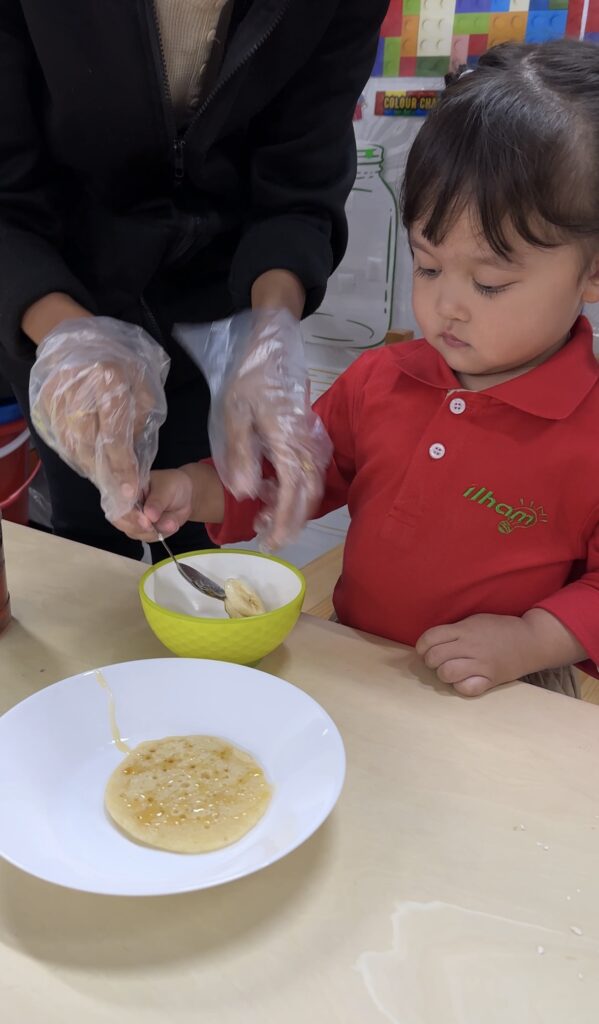
This is the non-negotiable starting point for most Muslim parents. But halal compliance is more nuanced than simply avoiding pork and lard. Genuinely halal-certified meals require that ingredients, preparation, and handling all meet MUIS (Majlis Ugama Islam Singapura) standards.
When enquiring about meals, ask specifically: Is the kitchen MUIS-certified? Are all ingredients from halal-certified suppliers? Is there cross-contamination prevention in place? A centre that takes halal seriously will answer these questions confidently.
2. Islamic Values in the Daily Environment
Beyond meals, look for centres where Islamic values are woven into the daily programme — not treated as a one-hour add-on. This includes the language and tone used by educators (kindness, patience, gratitude), how conflicts between children are resolved (through empathy and Islamic principles of fairness), and whether Islamic phrases and greetings are part of the environment.
Children absorb the culture of their environment. A childcare centre that genuinely embodies Islamic values — not just one that has an Arabic alphabet poster on the wall — will make a meaningful difference to your child’s early identity formation.
3. Quran and Arabic Exposure
For families who want their children introduced to the Quran and Arabic language from an early age, find out whether the centre incorporates IQRA reading, Quran listening, basic Arabic vocabulary, or age-appropriate dua (prayers). These do not need to be formal lessons for toddlers — even gentle, repeated exposure to the sounds and rhythms of the Quran during the early years has been shown to strengthen later Quran learning.
4. Malay Language Support
Singapore’s education system is predominantly English-medium, and this is entirely appropriate. But for Malay families, maintaining the mother tongue — especially in the early years before primary school — is both a cultural and practical priority. Malay is a scheduled subject in primary school, and children who enter Primary 1 with a stronger foundation in Malay consistently perform better.
Look for centres where Malay is spoken naturally among staff and incorporated into daily activities — not just taught as a structured language lesson once a week.
5. Educator Cultural Competency
Muslim parents consistently report that one of the most important factors — and one of the hardest to assess from a brochure — is whether educators genuinely understand and respect Muslim family life. This includes sensitivity around fasting month (Ramadan), religious observances, naming practices, and the values that Muslim families bring to the parent-centre relationship.
The best way to assess this is to visit the centre, meet the teachers, and ask direct questions. A culturally competent educator will engage thoughtfully — not defensively.
6. Prayer Facilities
For Muslim staff and older children who pray, access to a clean prayer space matters. While very young children do not yet pray formally, growing up in an environment where prayer is normalised — where teachers pray — is itself a powerful form of tarbiyah (Islamic upbringing).
Red Flags to Watch For
Not every centre that advertises itself as ‘Muslim-friendly’ genuinely delivers on that promise. Here are some warning signs:
- Halal meals ‘available on request’ rather than as standard — this suggests Islamic needs are an afterthought
- Vague answers to direct questions about MUIS certification or prayer arrangements
- Staff who are unfamiliar with basic Islamic practices such as dua or Ramadan
- A curriculum that makes no mention of character or values development
- High staff turnover — consistency of caregivers is especially important for younger children
The Ilham Childcare Difference: Built for Muslim Families in Singapore
Ilham Childcare was established with a clear mission: to provide Singapore’s Muslim families with a childcare option where Islamic values and holistic child development are not in tension — but are one and the same thing.
Our approach, which we call holistic Islamic childcare, integrates spiritual, intellectual, physical, emotional, and social development into every aspect of the programme. Here is what that looks like in practice at an Ilham centre:
| Dimension | What It Looks Like at Ilham |
|---|---|
| Spiritual (Ruhiyyah) | Daily dua, Quran listening, IQRA lessons, practical solat taught daily, Islamic character language, and Madrasah Entrance Test (MET) preparation from N2 onwards |
| Intellectual (Aqliyyah) | Structured learning, quadrilingual English-Malay-Mandarin-Arabic curriculum, early numeracy and literacy, and one-on-one MET preparation and IQRA tuition |
| Physical (Jismiyyah) | Gross and fine motor activities, outdoor play, halal-certified nutritious meals |
| Emotional (Nafsiyyah) | Empathy-based conflict resolution, emotional vocabulary, secure caregiver relationships |
| Social (Ijtima’iyyah) | Community values, sharing and turn-taking rooted in Islamic principles of fairness |
This five-dimensional framework — inspired by Islamic understanding of human development — ensures that no aspect of your child is overlooked. Islamic teachings are fully integrated from as young as two months old, meaning your child’s faith foundation begins the moment they join us. It is the reason Ilham was awarded Best Holistic Childcare Provider at the Asia Pacific Childcare Awards 2024.
Language at Ilham
Our programmes are conducted in English as the primary medium of instruction, with meaningful Malay, Mandarin, and Arabic woven into daily routines. Children hear Malay naturally in greetings, songs, and everyday conversation. Mandarin is integrated to give children a strong head start in Singapore’s bilingual education system. Arabic is introduced through dua, simple vocabulary, and exposure to the Quran — building a foundation that will serve them throughout their Islamic education.
Halal at Ilham
Halal compliance is not an option at Ilham — it is foundational. All meals served at Ilham centres use halal-certified ingredients and are prepared in accordance with MUIS guidelines. Muslim parents can be fully confident that their child’s dietary integrity is protected throughout the day.
Islamic Education at Ilham
Islamic education at Ilham goes far beyond what most centres offer. From as young as two months old, children are immersed in an Islamic environment — hearing Quranic recitation, greetings of salam, and values-based language from their very first days. As children grow, this deepens into structured Islamic learning woven into every part of the daily routine.
Practical Solat — Taught Daily
Solat is not just taught as a concept at Ilham — it is practised. Children learn the physical movements, recitations, and meaning of prayer on a daily basis, building a genuine, embodied connection to one of Islam’s most important pillars. By the time children leave Ilham, solat is a natural part of who they are.
Madrasah Entrance Test (MET) Preparation
For families who aspire for their child to attend madrasah, Ilham provides dedicated Madrasah Entrance Test (MET) preparation beginning from Nursery 2 (N2) onwards. This structured programme gives children the Islamic knowledge, Arabic literacy, and Quran foundation they need to succeed in the MET. One-on-one daily tuition is available for MET preparation, ensuring each child receives personalised support.
IQRA Lessons
IQRA reading is taught as part of the daily curriculum at Ilham. One-on-one IQRA tuition is also available, giving children the individual attention they need to progress through the books at their own pace. This early Quran literacy foundation sets children up for a lifelong connection to the holy book.
Questions to Ask Any Childcare Centre (as a Muslim Family)
- Is your kitchen MUIS halal-certified? Can I see the certification?
- Do your educators speak Malay? Is Malay used in daily routines?
- How do you incorporate Islamic values into the daily programme?
- Is there a prayer space available for staff? How is Ramadan handled?
- What is your approach to character development and discipline?
- Do you introduce children to basic dua or Quran listening?
- What is your staff retention rate? How long have your educators been with you?
Childcare Fees and Subsidies for Muslim Families
Government childcare subsidies in Singapore are available to all eligible families regardless of religion. Muslim families accessing Ilham Childcare are entitled to the same ECDA subsidies as any other family, including the Basic Subsidy and the Additional Subsidy based on household income.
For a detailed breakdown of current fees and subsidies at Ilham, visit our Fees & Subsidy page or contact your nearest Ilham branch directly. Our team will walk you through exactly what financial support is available for your family.
| Finding childcare that honours your faith should not mean paying a premium beyond your means. Ilham’s fee structures are designed to be accessible, and our team will help every family navigate the subsidy landscape. |
Frequently Asked Questions
Is there Islamic childcare near me in Singapore?
Ilham Childcare operates multiple branches across Singapore — in Boon Lay/Jurong West, Woodlands, and Ubi. Each branch provides the full Ilham Islamic childcare experience. Use our branch locator or contact us to find your nearest centre.
At what age should my child start?
Ilham accepts children from two months (infant care) through to Kindergarten 2. The earlier children begin in a consistent, values-aligned environment, the stronger their developmental foundation becomes.
What languages are used at Ilham?
Our primary instruction language is English, with meaningful Malay, Mandarin, and Arabic integrated into daily routines. We believe quadrilingual exposure — English, Malay, Mandarin, and Arabic — gives our children in Singapore an exceptional foundation.
Is Ilham only for Malay families?
Not at all. While our Islamic values framework is rooted in the Muslim tradition, Ilham warmly welcomes families from all backgrounds who appreciate a values-based, holistic approach to early childhood education. Our diverse parent community reflects Singapore’s multicultural spirit.