 Take the First Step
For Every Parent Who Has Wondered Whether Their Child Will Belong
If you are raising a child with additional learning needs, developmental differences, or a diagnosed condition, you already know that choosing a preschool is not simply a matter of location, fees, or curriculum brochure. It is about finding a place where your child will be genuinely seen, supported, and valued — not accommodated as an afterthought, but welcomed as a full and important member of the community.
The good news is that Singapore’s early childhood landscape for children with additional needs has evolved meaningfully over the past decade. There are more pathways, more support schemes, and more genuinely inclusive preschools today than at any previous point. The more difficult reality is that navigating this landscape — with its assessments, acronyms, waiting lists, and varied quality — remains genuinely challenging for families.
This guide is written to make that navigation a little easier. We cover what the key terms actually mean, which Singapore support programmes your family should know about, what genuine inclusion looks like in practice, and the specific questions that will help you find the right environment for your child.
Understanding the Key Terms: What Singapore’s System Actually Means
Parents new to this space often encounter terminology that is used inconsistently and can feel opaque. Here is a plain-language breakdown:
Specialised Early Intervention Centres
These are dedicated centres designed specifically for children with moderate to significant developmental needs. They feature specialist educators, small group sizes, intensive therapeutic support across multiple domains (speech therapy, occupational therapy, physiotherapy, psychology), and structured developmental programming. In Singapore, many operate under voluntary welfare organisations (VWOs) with regulatory oversight from ECDA and the National Council of Social Service (NCSS).
Conditions commonly supported include Autism Spectrum Disorder (ASD), Down Syndrome, Global Developmental Delay, cerebral palsy, sensory processing differences, and physical disabilities.
Inclusive Mainstream Preschools
Inclusive preschools are mainstream childcare centres and kindergartens that have made a genuine commitment to welcoming and supporting children with additional needs alongside their typically-developing peers. True inclusion requires trained educators, individualised support planning, adapted teaching approaches, and an intentional school culture of belonging — not just physical enrolment.
The quality of inclusion varies significantly between centres. When evaluating an inclusive mainstream preschool, look beyond marketing language and ask specific, concrete questions about how support is actually delivered day to day.
Supported Integration — The Inclusive Support Programme (ISP)
Some mainstream ECDA-licensed preschools participate in the government’s Inclusive Support Programme (ISP), which provides trained Inclusion Support Specialists and additional resources to support the integration of children with mild to moderate additional needs into mainstream classrooms. If Madrasah preparation and a holistic environment are priorities alongside inclusion, families should ask specifically whether a centre participates in ISP.
Why the Preschool Years Are the Most Important Window for Early Intervention
The urgency that specialists and educators place on early intervention is not arbitrary. It is grounded in one of the most robust findings of modern neuroscience: the first five years of life represent a period of extraordinary neurological plasticity. The brain is building connections at a rate that will never again be replicated, and the quality of early experience shapes that development in ways that are genuinely and durably long-lasting.
For children with additional developmental needs, this means that targeted, high-quality support during the preschool years delivers disproportionately large returns. Research consistently demonstrates that children who access appropriate early intervention make significantly greater developmental progress than those who receive equivalent support beginning at primary school age. The gap compounds over time: early intervention opens doors; delayed intervention narrows them.
💡 If you have concerns about your child’s development — speech, social interaction, attention, motor skills, or behaviour — speaking with your paediatrician as early as possible is the most important first step. In Singapore, developmental assessments are available through KK Women’s and Children’s Hospital (KKH), National University Hospital (NUH), and community health partners.
Singapore’s Key Support Schemes: What Your Family May Be Entitled To
Singapore has invested substantially in early intervention infrastructure. Here is a clear overview of the primary schemes families should be aware of:
EIPIC — Early Intervention Programme for Infants and Children
EIPIC is the cornerstone of Singapore’s early intervention system for children aged below seven who have been assessed with developmental needs. It is delivered through a network of ECDA-funded specialised centres operated by VWOs including AWWA, APSN, Cerebral Palsy Alliance Singapore (CPAS), Rainbow Centre, SPD, and others.
EIPIC provides integrated developmental programming, specialist therapy, and family support. Fees are heavily means-tested, with significant government subsidy ensuring access across income levels. A referral from a registered medical professional is required.
ISP — Inclusive Support Programme
The ISP enables children with mild developmental needs to attend mainstream ECDA-licensed preschools with the support of trained Inclusion Support Specialists deployed to those centres. Children receive the social and developmental benefits of learning alongside typically-developing peers while still receiving targeted individual support. Ask whether any preschool you are considering is an ISP-registered centre.
KidSTART
KidSTART is a targeted early intervention programme for children from lower-income families aged zero to six. It provides home visits, developmental monitoring, and structured centre-based activities — serving as both a support programme and an early identification and referral pathway for families who might not otherwise access formal services.
ComCare Early Intervention Fund (NCSS)
For families experiencing financial hardship, the ComCare Early Intervention Fund provides assistance with costs related to early intervention therapy, specialised programmes, and assistive equipment. Families should approach their nearest Social Service Office or speak with a medical social worker at their hospital for assessment and referral.
What Genuine Inclusion Looks Like in a Preschool — Beyond the Brochure
The word ‘inclusive’ is used widely in Singapore’s early childhood marketing. Here is what separates genuine, high-quality inclusion from surface-level positioning:
Trained and Confident Educators
Ask specifically what training the educators who will work directly with your child have received in supporting children with additional needs. In a genuinely inclusive setting, this training extends to all classroom educators — not just a specialist — and covers differentiated teaching approaches, positive behaviour support, and understanding of common developmental profiles.
Individualised Education Plans (IEPs)
A preschool that meaningfully supports children with additional needs will have a clear process for developing an Individualised Education Plan for your child — setting out specific developmental goals, support strategies, and how progress will be tracked and communicated to your family. Ask to see an example IEP structure and ask who is responsible for developing and reviewing it.
Genuine Family Partnership
You should expect regular, substantive communication about your child — not just a termly written report, but ongoing dialogue. Quality inclusive preschools treat parents as partners and experts on their own children. They should welcome your input, be transparent about challenges, and actively involve you in planning.
Thoughtful Physical Environment
Observe the physical space. Is the classroom calm and organised, or visually overwhelming and acoustically loud? Are there quiet corners or calm-down spaces? Is the layout navigable for children with motor challenges? Physical environment matters enormously for many children with sensory sensitivities — which is common across many developmental profiles.
A Culture of Belonging, Not Just Access
Pay attention to the culture. Genuine inclusion is not about physical access alone — it is about whether every child is genuinely known, celebrated, and treated as a full member of the community. Listen to how the school’s leadership talks about children with additional needs. Is the language warm, specific, and confident? Or does it carry hesitation and disclaimers?
Questions to Ask When Visiting a Preschool for a Child with Additional Needs
Beyond the standard visit questions, parents of children with additional needs should ask these directly:
- Has this centre previously supported children with a profile similar to my child’s? What did that support look like, and what were the outcomes?
- Are you registered as an ISP preschool? If so, how is Inclusion Support Specialist time allocated?
- Who is my child’s primary educator contact, and how regularly will we communicate?
- What is your process for developing an Individualised Education Plan, and how often is it reviewed?
- How do you handle situations where a child’s behaviour or support needs increase or change?
- What is your referral process if my child needs speech therapy, occupational therapy, or psychological support?
- How do you actively support peer relationships and social integration — not just physical co-presence, but genuine belonging?
- What does transition planning look like if my child moves between support levels or programmes?
A preschool that answers these questions with specificity and warmth has genuinely thought about inclusion. One that seems surprised, defensive, or vague may not be the right fit.
How Ilham Childcare Approaches Inclusive and Supportive Education
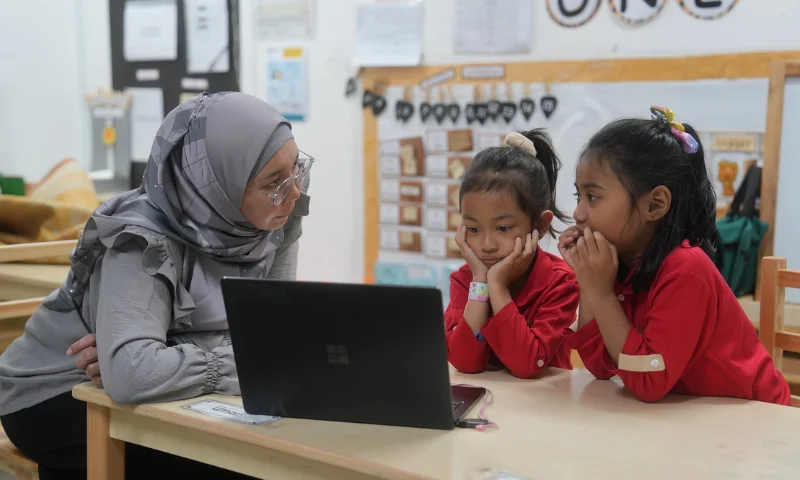
At Ilham Childcare, our foundational belief is that every child is unique — in their strengths, their pace, their interests, and their needs — and that our role as educators is to create conditions where every child can grow into their fullest potential. This is not a statement that applies only to typically-developing children. It is a commitment that shapes every enrolment conversation, every classroom, and every day.
Our holistic development model — integrating cognitive, social, emotional, physical, and spiritual dimensions of development within our Islamic values framework — provides a naturally inclusive foundation. We believe in the dignity of every child, and that belief is expressed daily in the warmth and attentiveness of our educators.
Ilham’s curriculum is designed to meet children where they are. Our nine enrichment programmes are delivered across all levels precisely because we believe every child deserves access to music, movement, creative arts, language, and hands-on learning — regardless of their developmental starting point. Our four-language daily immersion and small class sizes mean that children receive consistent, individualised educator attention as a matter of course.
This matters especially for families navigating additional needs. The enrichment your child receives at Ilham — music, movement, creative arts, cookery, phonics, and more — is not a bolt-on: it is woven into the fabric of every day. For many families, this means that the curriculum itself is already providing the rich, varied, developmental experience they were hoping to find through external classes. Before adding sessions to your child’s week, it is worth reflecting on whether their preschool day is already full and purposeful — and whether protecting unstructured time at home might serve them better than stacking further activities. Children with additional needs, in particular, can benefit greatly from the predictability and calm of unhurried afternoons.
For families with children who have identified additional needs, we encourage an early, open, and honest conversation with our team before enrolment. We want to understand your child fully — their strengths as much as their challenges — and to be transparent about the level of support we can provide. Where appropriate, we actively connect families with Singapore’s broader network of early intervention resources and specialist services.
🌟 #YourChildNeverWalksAlone: This commitment — which underpins our decision to include all enrichment programmes and four-language learning at no extra cost — extends to how we approach every family who walks through our doors. Every child deserves the same quality of experience, the same warmth of welcome, and the same investment of educator attention.
Practical Next Steps for Families Starting This Journey
If you are in the early stages of navigating early childhood support for your child, here is a clear sequence of practical next steps:
- Speak with your paediatrician. If you have any developmental concerns, raise them explicitly. Request a developmental assessment referral. Early assessment is the foundation for everything that follows.
- Obtain a formal developmental assessment through KKH, NUH, or a community developmental specialist. This will clarify your child’s profile and open the door to appropriate programmes and subsidies.
- Explore EIPIC and ISP options through ECDA. Visit www.ecda.gov.sg for current information on EIPIC centre locations, application processes, and ISP-registered preschools in Singapore.
- Visit preschools with specific questions. Use the list in this guide. Visit in person, observe the environment and educator-child interactions, and trust your instincts.
- Connect with peer support communities. Autism Resource Centre Singapore, Down Syndrome Association Singapore, and SNAP (Special Needs Action and Planning) offer peer support and practical guidance for families navigating this journey.
Seek financial assistance early if needed. Speak with a medical social worker at your hospital or contact NCSS about ComCare Early Intervention Fund eligibility — do not wait until finances become a barrier
A Final Word to Every Parent Reading This
The journey of raising a child with additional needs — especially through the early years — asks a great deal of parents. It involves navigating systems that were not always designed with your family in mind, making decisions under uncertainty, and advocating consistently for a child who depends on you completely.
What the research, and the lived experience of thousands of Singapore families, consistently shows is this: the quality of early support matters enormously. And children with additional needs, given the right environment and the right community, are capable of extraordinary growth.
You do not need to have all the answers today. You need honest information, compassionate professionals, and a community that will walk alongside you.
Ilham Childcare is a community built on the belief that your child never walks alone. If you would like to speak with us about whether we are the right fit for your child’s needs, we welcome that conversation — openly, honestly, and without pressure.