 Take the First Step
For Muslim families in Singapore, early childhood education is not just about academic preparation — it is about nurturing a child who knows their deen, carries good character, and grows up with a secure sense of identity rooted in faith. Finding a childcare centre that genuinely integrates Islamic education alongside quality early learning is one of the most meaningful decisions a Muslim parent can make.
This guide covers everything you need to know: what authentic Islamic early childhood education looks like, why the early years are the most critical window for Islamic values formation, how Madrasah Entry Test preparation fits into a quality programme, and how to find — or evaluate — an Islamic preschool or childcare centre in Singapore.
Why the Early Years Are the Most Important Window for Islamic Education
The Prophet Muhammad (peace be upon him) described the human being as born upon the fitrah — the natural disposition towards goodness, truth, and the recognition of Allah. Islamic scholars across traditions have long emphasised that the early years, particularly from birth to age seven, represent the most receptive period for values formation, character development, and spiritual attachment.
This aligns profoundly with what modern developmental neuroscience tells us: 90% of a child’s brain development occurs before the age of five. The attachments formed, the language absorbed, the habits practised, and the values observed in these early years lay a neural architecture that shapes the child’s entire life trajectory.
For Muslim parents in Singapore, this means the choice of preschool or childcare centre is not merely about academic readiness or convenience. It is about which environment will be shaping your child’s heart, mind, and character during the most formative years of their life.
🌙 Key Insight for Parents: Research in early childhood development consistently confirms what Islamic tradition has always known — the character traits, spiritual habits, and emotional foundations formed before age six are the most durable across a child’s lifetime. Choosing an environment that reinforces your Islamic values is not an additional consideration. It is central to your child’s holistic development.
What Is Islamic Early Childhood Education? Beyond Quran Recitation
Many parents assume Islamic education for young children means Quran classes and learning to recite surah. While Quran exposure is certainly a component, authentic Islamic early childhood education is far broader and deeper than recitation alone.
Genuine Islamic early childhood education encompasses five interconnected dimensions:
1. Aqidah — Foundation of Faith and Identity
Aqidah refers to the correct belief and creed that forms the child’s fundamental understanding of Allah, His attributes, the prophets, and the purpose of life. At the preschool level, aqidah is introduced gently through:
- Daily dua (supplications) before meals, upon waking, entering the classroom, and throughout key moments of the day
- Stories of the Prophets narrated at a level appropriate to the child’s age and understanding
- Simple explanations of why we thank Allah for the food we eat, the people we love, and the world we see
- Reinforcing the child’s identity: ‘I am a Muslim, I love Allah, Allah loves me’
This early aqidah formation is not about rote memorisation of theological concepts — it is about building a secure, loving relationship with Allah that the child carries naturally into later, more detailed Islamic learning.
Akhlaq — Character and Moral Development
Akhlaq refers to the Islamic understanding of good character and ethical conduct. The Prophet (peace be upon him) said: ‘I have been sent to perfect good character.’ This places character formation at the heart of what Islamic education is for.
In an Islamic preschool setting, akhlaq education is woven into every interaction, not delivered as a lesson:
- Teachers model and praise honesty, kindness, patience, and gratitude consistently and explicitly
- Children are taught to say salaam, make eye contact, and show respect to adults and peers
- Conflict resolution is handled through Islamic values frameworks — forgiveness, communication, empathy
- Sharing, generosity, and care for others are celebrated as religious virtues, not merely social niceties
Ibadah — Worship Habits and Daily Practice
Young children in Islamic preschools are introduced to the habits of worship in age-appropriate, joyful ways. This includes:
- Learning to make wudu (ablution) — physical cleanliness as an act of worship
- Observing or participating in simplified versions of salah, understanding what prayer means and why Muslims pray
- Learning basic surahs, dua, and Asmaul Husna through songs, repetition, and play
- Understanding fasting and its significance at an age-appropriate level, particularly during Ramadan
- Celebrating Islamic milestones — Eid, the Prophet’s birthday — with joy and meaning
Quran Exposure — Listening, Recitation, and Love of the Book
Quran education for young children in Singapore should focus first on building love for the Quran — not performance or memorisation pressure. Effective Quran programmes for preschoolers include:
- Regular listening to beautiful Quran recitation in the classroom environment
- Gradual introduction of short surahs through repetition, melody, and movement
- IQRA-based learning: systematic phonics-style introduction to the Arabic alphabet and syllable joining
- Praise and encouragement for effort, not perfection — building a positive emotional association with the Quran
- Connection between Quranic verses and everyday life experiences
Children who grow up hearing and gently engaging with the Quran from infancy develop a profound familiarity with its cadence and sound that accelerates later formal Quran learning significantly.
5. Malay Language and Cultural Identity
For Malay-Muslim families in Singapore, Islamic education is inseparable from cultural and linguistic identity. The Malay language carries the vocabulary of Islamic practice, family relationships, and community values. Preschools that support Malay language development alongside Islamic education help children build a coherent, confident identity.
Singapore’s bilingual policy means children must develop strong mother tongue proficiency from early childhood. An Islamic childcare centre that delivers mother tongue instruction through a culturally resonant Islamic framework creates a powerful, integrated learning experience.
🕌 Ilham’s Ukhrawi Programme: At Ilham Childcare, our Ukhrawi programme integrates all five dimensions of Islamic education — aqidah, akhlaq, ibadah, Quran, and Malay cultural identity — into a seamless daily curriculum. This is not an add-on religious class. Islamic values are the framework through which all learning happens at Ilham. Learn more about our approach
Madrasah Entry Test (MeT) Preparation: Why It Matters and How Ilham Prepares Your Child
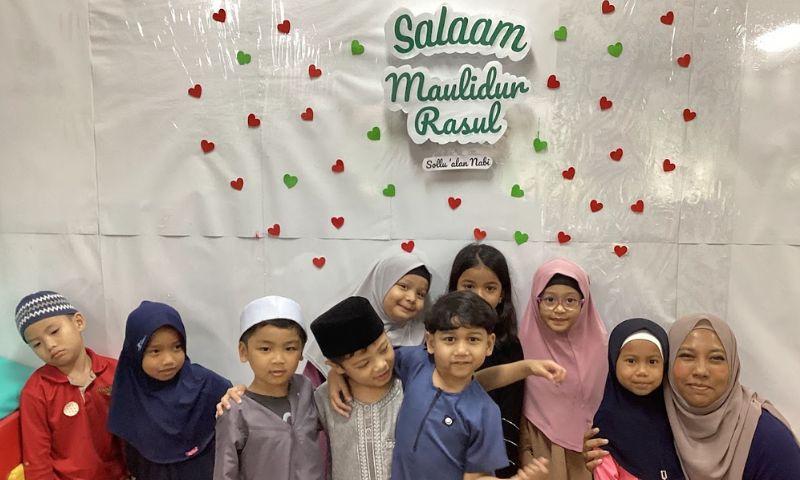
For many Muslim families in Singapore, the journey of Islamic education does not end at preschool — it continues into formal Madrasah. Whether a family chooses a full-time Madrasah or a part-time religious school, the Madrasah Entry Test (MeT) is a significant milestone that many children encounter on the transition from preschool to primary education.
At Ilham Childcare, we take this milestone seriously. We believe that preparing a child for the MeT is not simply about examination technique — it is about ensuring that by the time your child reaches Kindergarten 2, they have genuinely internalised the Islamic knowledge, Quran literacy, and spiritual habits that will set them up for a lifetime of meaningful Islamic learning.
⭐ A Note for Singapore Parents: The Madrasah Entry Test is a key admissions pathway for children seeking to enrol in Singapore’s full-time Madrasahs. Solid IQRA progression, surah memorisation, and aqidah understanding from preschool gives children a meaningful head start — and reduces the pressure families often feel in the lead-up to the test.
Our Intensive Programme Begins at Nursery 2
While Islamic values and Quran exposure begin from the very first day a child joins Ilham Childcare, our structured and intensive MeT preparation programme begins at Nursery 2 (N2) — typically when children are four years old. This is the developmental stage at which children have sufficient language, attention, and cognitive maturity to benefit from more structured Islamic academic engagement.
Starting at N2 gives children a full two years of structured preparation before the typical MeT assessment window — enough time to build genuine competence, not just surface familiarity.
One-on-One IQRA Sessions: Personalised, Progressive, and Purposeful
One of the hallmarks of Ilham’s MeT preparation approach is our commitment to individual IQRA instruction. Rather than relying solely on group-based Quran learning — which, while valuable, cannot account for the significant variation in children’s readiness and pace — we provide dedicated one-on-one IQRA sessions for children from N2 onwards.
These individual sessions allow our educators to:
- Accurately track exactly where each child is in their IQRA progression at all times
- Pace the child’s advancement through IQRA levels based on genuine readiness, not a fixed group timeline
- Identify and address specific letter recognition or tajweed challenges before they become ingrained habits
- Give children the focused attention and encouragement that builds genuine confidence in their Quran reading
- Provide regular, meaningful progress updates to parents — so families can reinforce IQRA practice at home
IQRA levels covered progressively from N2 through K2 include Arabic letter recognition, letter joining and syllable formation, short and long vowels, tanwin, and basic reading of simple Quranic text. By Kindergarten 2, children who have followed Ilham’s IQRA pathway consistently are typically at IQRA Level 3 or beyond — a strong foundation for MeT assessment and continued Quran education at Madrasah.
📖 IQRA Progression at Ilham: Children who begin one-on-one IQRA sessions at N2 and attend consistently through K2 typically complete IQRA Levels 1–3 before Primary 1 — giving them a genuine Quran literacy foundation, not just memorised recitation.
Daily Dua — Building the Habit of Speaking to Allah
At Ilham Childcare, dua is not a lesson. It is a living, daily practice that runs through every moment of the child’s day. We believe deeply that the habit of turning to Allah — of speaking to Him naturally, confidently, and from the heart — is one of the most valuable things we can give a child in the preschool years.
Our daily dua programme covers supplications that children will need for the MeT, and far more importantly, that they will carry and use throughout their lives:
- Dua upon waking (Dua Bangun Tidur) and dua for sleep
- Dua before and after eating — recited with understanding, not just habit
- Dua when entering and leaving the home and classroom
- Dua for parents — understanding why we make dua for those who care for us
- Dua for knowledge (Dua Sebelum Belajar) — said together before every learning session
- Dua when it rains, when travelling, and for protection
- Morning and evening adhkar — simplified for preschool age but taught with their meaning
Each dua is taught with a brief, age-appropriate explanation of its meaning. Children at Ilham do not just recite — they understand why they are making dua, and to Whom. This understanding is the difference between a child who performs religious routine and a child who is beginning to develop genuine tawakkul.
Surah Programme — From Juz Amma to Surah Yassin
Ilham’s surah memorisation programme is structured, progressive, and deeply intentional. It is designed not just to prepare children for MeT surah requirements, but to fill their hearts with the words of Allah — surah by surah, from the earliest years through to Kindergarten 2.
Our surah programme proceeds through the following progression:
| Stage | Surahs Covered | Approach |
|---|---|---|
| Infant Care / Toddler | Quran audio environment; Al-Fatihah listening | Passive exposure through recitation played in classroom |
| Playgroup / N1 | Al-Fatihah, Al-Ikhlas, An-Nas, Al-Falaq | Repetition through song, movement, and group recitation |
| N2 (Intensive begins) | Al-Asr, Al-Kawthar, Al-Maun, Al-Fil, Al-Humazah | Group + individual reinforcement; meaning introduced |
| Group + individual reinforcement; meaning introduced | Al-Qariah, Al-Adiyat, Al-Zilzalah, Al-Bayyinah, Al-Qadr | Structured memorisation with tajweed focus; regular individual checks |
| K2 (MeT readiness) | Al-Alaq, At-Tin, Al-Inshirah, Ad-Duha + review of all prior surahs | Consolidation, confidence building, and MeT recitation preparation |
| Extended / Advanced | Surah Yassin and selected longer surahs for advanced learners | Introduced for children who have completed Juz Amma progression |
Surah Yassin holds a place of particular significance in the hearts of Singapore’s Muslim community. For children who have progressed through the Juz Amma curriculum and are ready for longer surahs, Ilham’s educators introduce Yassin through listening, gradual verse-by-verse engagement, and contextual explanation of its themes — building familiarity and love for this noble surah from a young age. Our educators understand that memorisation should never be pressurised or rushed. A child who memorises Al-Ikhlas with genuine love and understanding has achieved more than one who recites ten surahs without knowing what they mean
🌙 At Ilham, surah learning is always paired with age-appropriate tafsir — the child learns not just the words of Allah, but begins to understand their meaning and beauty. This is what transforms recitation into genuine connection with the Quran.
Ilham’s MeT Preparation Programme at a Glance
| MeT Component | How Ilham Prepares Your Child |
|---|---|
| IQRA / Arabic Reading | One-on-one IQRA sessions from N2; progressive through IQRA Levels 1–3 by K2 |
| Surah Recitation | Structured surah programme from Playgroup; Juz Amma progression completed by K2 |
| Daily Dua | Daily dua practice embedded throughout every school day from Infant Care |
| Aqidah Knowledge | Age-appropriate aqidah introduced from N1; deepened through stories, discussion, and routine |
| Akhlaq & Character | Islamic character modelled and reinforced by all educators across every interaction daily |
| Malay Language | Malay instruction integrated with Islamic content throughout the curriculum |
| Ibadah Understanding | Salah, wudu, fasting explained and practised age-appropriately from N1 onwards |
📋 For parents considering Madrasah enrolment: We strongly encourage early conversation with our educators about your child’s MeT preparation pathway. Our team can advise on your child’s current IQRA level, surah progress, and readiness — and work with you on an individualised plan for the K2 year. Speak with our team → /contact/ or visit us at an Open House → /open-house/
The Landscape of Islamic Childcare in Singapore: What Parents Are Working With
Are Working With
Singapore’s preschool sector is large and well-regulated. ECDA oversees more than 1,000 licensed childcare centres across the island. However, the number of centres offering genuine, integrated Islamic education — not merely a Muslim-majority student body — remains limited.
Most preschools in Singapore that cater to Muslim families fall into one of three categories:
| Type | Description | Islamic Education Depth |
|---|---|---|
| General licensed preschool | Standard curriculum, no Islamic differentiation | Minimal or none |
| Muslim-operated but secular | Run by Muslim operators, curriculum follows standard framework only | Low — cultural familiarity, not curriculum integration |
| Integrated Islamic preschool | Explicitly Islamic curriculum with Quran, dua, akhlaq, and Malay integration | High — Islam is the curriculum framework |
For families who want Islamic education genuinely integrated into every aspect of their child’s preschool experience — not delivered as an afterthought 20 minutes per day — the third category is the only option. And in Singapore, true integrated Islamic childcare centres represent a very small subset of the licensed preschool market.
What to Look for in an Islamic Preschool in Singapore: 8 Questions to Ask
When evaluating an Islamic childcare centre in Singapore, go beyond the brochure. Ask these questions during your centre visit:
How is Islamic education integrated into the daily timetable?
? Is it a dedicated 20-minute class, or is it woven throughout the day? The latter indicates genuine integration
What is the teachers’ own Islamic knowledge and practice?
? Educators who embody Islamic character model it naturally for children. Ask about teacher training in Islamic early childhood education.
How is Quran taught, and what is the approach?
Is there IQRA-structured Arabic phonics? Are one-on-one sessions available? Is the focus on love and exposure first, or memorisation performance?
Does the centre offer structured MeT preparation?
For families with Madrasah aspirations, ask specifically what the centre’s MeT programme looks like, when it begins, and how individual progress is tracked.
What languages are taught, and how?
English, Malay, and ideally Arabic. How are they balanced across the timetable?
How are Islamic values handled when children misbehave?
Discipline approaches reveal whether Islamic values are surface decoration or genuine pedagogical foundation.
Is the centre ECDA-licensed?
Licensing ensures safety standards, qualified educators, and eligibility for government subsidies — non-negotiable
What is the teacher-to-child ratio, and how stable is the teaching team?
High turnover in an Islamic childcare setting means children lose their relationship with teachers who model Islamic character — critical for this age group.
Costs and Government Subsidies for Islamic Childcare in Singapore
A common concern among Muslim families is whether choosing an Islamic childcare centre means forgoing government subsidies. The answer depends on the centre’s operator status.
ECDA-licensed Islamic childcare centres that operate as Anchor Operators (AO) or Partner Operators (PO) are eligible for the full range of government childcare subsidies, including:
- Basic Subsidy: Up to S$600/month for full-day infant care; up to S$300/month for full-day childcare
- Additional Subsidy (means-tested): Up to S$467/month for lower-income families in infant care
- CDA (Child Development Account): For use at approved centres
- MediSave: For infant care registration fees at approved centres
Parents should verify directly with the centre whether it holds AO or PO status, as this determines subsidy eligibility. Some quality Islamic centres are Partner Operators, making them highly affordable when subsidies are applied.
💰 Ilham‘s Fees and Subsidy Information: Ilham Childcare is an ECDA-licensed centre. Full fees and subsidy eligibility information is available on our Fees & Subsidy page. View our current fees and subsidy
Islamic Education Across Different Ages: What to Expect at Each Stage
Infant Care (2 months – 18 months)
Islamic education in infant care is entirely about environment and atmosphere. Infants absorb the world through their senses and emotional attachments. In an Islamic infant care setting, this means:
- Quran playing softly in the classroom environment
- Caregivers who speak gently, use Islamic greetings, and embody rahma (mercy and compassion)
- Islamic art, calligraphy, and colours in the physical environment
- A halal-only nutrition policy for all food provided
Toddler and Playgroup (18 months – 3 years)
At this stage, children are developing language rapidly and beginning to form their first social relationships. Islamic education becomes more active:
- Learning to say Bismillah before eating and Alhamdulillah after
- Simple dua recited together as a class routine
- Stories of animals, nature, and the world that point to Allah’s creation
- Songs and movements that introduce the names of Allah and basic Islamic concepts
Nursery 1 and 2 (3–4 years)
Children in this stage are developing a genuine capacity for moral reasoning and religious questioning. Islamic education deepens considerably, and at N2, Ilham’s intensive one-on-one IQRA and structured MeT preparation begins:
- Introduction to the five pillars of Islam at a child’s level
- Beginning IQRA Arabic phonics through one-on-one sessions — letter recognition and sounds
- Systematic learning of short surahs: Al-Fatihah, Al-Ikhlas, Al-Falaq, An-Nas, Al-Asr, Al-Kawthar, and more
- Stories of the Prophets with moral lessons drawn explicitly
- Daily dua practice embedded throughout the school day with meaning-based explanation
- Understanding halal and haram in accessible, practical terms
Kindergarten 1 and 2 (5–6 years)
This is the final preschool stage before Primary 1 — and for families with Madrasah aspirations, the most critical period of MeT preparation. Islamic education at this level is substantive, structured, and intentional:
- Progressing through IQRA Levels 2–3 and beyond — developing confident Arabic reading ability
- Memorising and reviewing the full Juz Amma surah programme, including selected longer surahs
- Understanding of salah — including the meaning of what is recited in each position
- Discussion of Islamic conduct in real-world social situations — friendship, honesty, fairness, digital life
- Intensive MeT preparation: surah recitation, dua review, aqidah assessment readiness, and confidence building
- Preparation for transition to Islamic primary education — Madrasah or MOE school with Muslim chaplaincy
📚 Ilham’s Programme Structure: Ilham Childcare offers programmes from Infant Care through Kindergarten 2, with Islamic education and MeT preparation integrated at every stage. View our full programme offering → /programmes/ Infant Care details → /infant-care/ Kindergarten programme → /kindergarten/
The Role of Parents: Building a Consistent Islamic Environment at Home
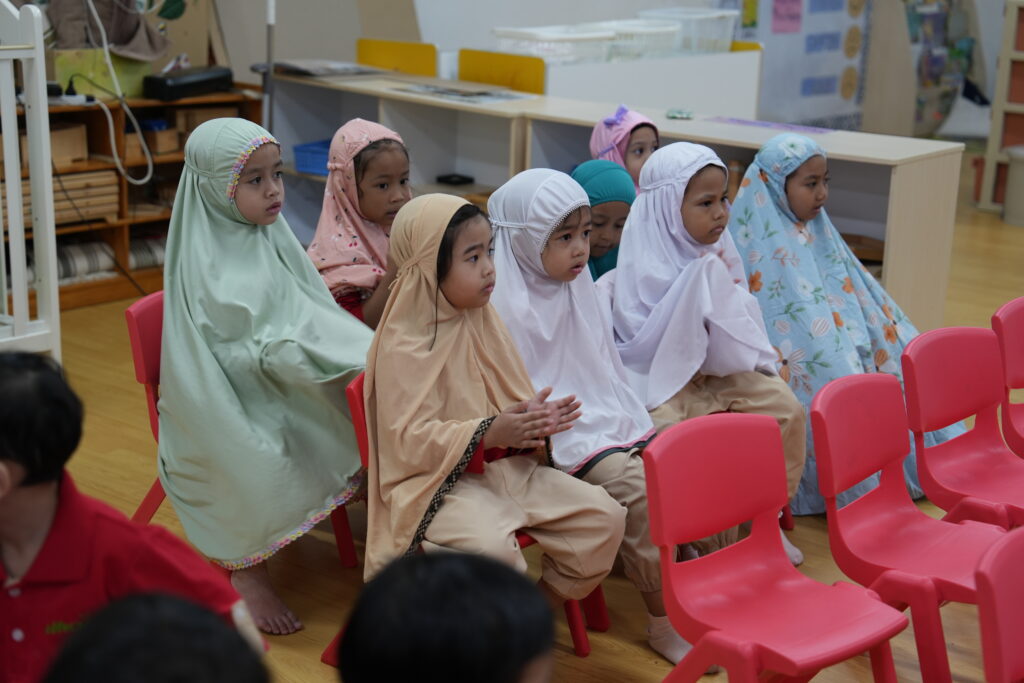
Even the best Islamic preschool can only do so much. The home environment — and particularly the parents’ own practice and character — is the most powerful Islamic education a child receives.
Research in early childhood development consistently finds that children’s values and beliefs are shaped most strongly by observation of the significant adults in their lives. The preschool provides a structured, formal Islamic learning environment. But the mother making wudu in the morning, the father reciting Quran after Fajr, the family gathering for Eid — these are the images that settle deepest.
Practical ways Singapore parents can reinforce Islamic education at home:
- Establish regular dua routines — morning and bedtime supplications create powerful daily anchors that complement what children learn at Ilham
- Recite Quran in the home environment, even if only listening to recordings during family time
- Use Islamic language naturally: ‘Alhamdulillah’, ‘Insha Allah’, ‘Bismillah’ in everyday conversation
- Read age-appropriate Islamic storybooks — the market for high-quality English and Malay Islamic children’s literature in Singapore has grown significantly
- Visit the mosque with children during low-traffic times — making it familiar and safe rather than formal and intimidating
- Connect Islamic values to everyday life: ‘We share because the Prophet (peace be upon him) loved generosity’
- Ask your child what dua they learned at Ilham that day — reinforcing it together at home accelerates both memorisation and meaning
🌙 A parent who practises consistently at home and a child who is learning at an Islamic preschool create a powerful, mutually reinforcing environment. Ilham’s educators are always happy to share what dua and surahs your child is currently working on — so home and school can work together.
Frequently Asked Questions: Islamic Education for Children in Singapore
At what age should Islamic education begin for children?
Islamic education begins at birth — through the environment, the sounds the child hears, the language of the home, and the character of the caregivers. Formal introduction of dua, surahs, and aqidah concepts begins naturally from age 2–3, when language development allows children to begin engaging meaningfully with verbal religious content. At Ilham, our intensive structured programme — including one-on-one IQRA — begins at N2 (age 4).
Is there an Islamic preschool in Singapore that also qualifies for government subsidies?
Yes. ECDA-licensed Islamic childcare centres that hold Anchor Operator or Partner Operator status are eligible for government childcare subsidies. Ilham Childcare is an ECDA-licensed centre — contact us directly to confirm current subsidy eligibility and fee structures.
Does Ilham Childcare offer specific Madrasah Entry Test (MeT) preparation?
Yes. Ilham’s intensive MeT preparation programme begins at Nursery 2 (N2) and continues through Kindergarten 2. It includes one-on-one IQRA sessions, a structured surah memorisation programme, daily dua practice, and aqidah preparation. Our educators track each child’s individual progress and communicate regularly with families. Families with Madrasah aspirations are strongly encouraged to speak with our team early about their child’s preparation pathway.
What is the difference between Islamic childcare and a regular childcare centre with Muslim students?
An Islamic childcare centre integrates Islamic values, Quran exposure, aqidah, akhlaq, and dua into the curriculum and daily environment. A regular centre with Muslim students simply happens to enrol children from Muslim families but does not actively incorporate Islamic education. The distinction matters significantly for families who want their child’s religious identity nurtured and their MeT preparation supported — not just tolerated.
Can non-Malay Muslim children benefit from Islamic childcare in Singapore?
Absolutely. Islam transcends ethnicity, and a genuinely Islamic curriculum is relevant and valuable for all Muslim children regardless of ethnic background. Most Islamic childcare centres in Singapore serve diverse Muslim communities including Malay, Indian Muslim, Arab, and convert families. The core values — aqidah, akhlaq, ibadah, Quran — are universal to all Muslims.
What is the IQRA method and is it used at Ilham Childcare?
IQRA is a systematic method for teaching Arabic reading through a phonics-based progression, widely used across Singapore and Southeast Asia. It introduces children to Arabic letter recognition, sounds, and syllable joining in a sequential, structured way. Ilham Childcare uses IQRA as the foundation of our Quran literacy programme, delivered through individual one-on-one sessions from N2 onwards to ensure each child progresses at their own pace.
How do I know if an Islamic preschool is teaching Islam correctly?
Look for alignment with mainstream Sunni Islamic scholarship and Singaporean Muslim authority (MUIS). Check whether the centre’s Islamic curriculum has been reviewed by qualified scholars or endorsed by reputable Islamic bodies. Ask about the Islamic credentials of the curriculum designers and educators. Visit the centre and observe how Islamic values are modelled in practice — not just stated in the brochure.
Conclusion: Islamic Education Is a Lifelong Investment
The first six years of a child’s life are an extraordinary gift and an extraordinary responsibility. The values, habits, language, and spiritual orientation formed in these years are not easily undone — nor should they be. They are the foundation upon which everything else is built.
For Singapore’s Muslim families, choosing an Islamic childcare centre is one of the highest-return investments you will ever make in your child’s future. Not because it guarantees a child who prays five times a day at age six, but because it plants seeds — of identity, of love for Allah and His Messenger, of good character and honest relationships — that grow quietly and steadily over a lifetime.
And for families with Madrasah aspirations, that foundation matters practically too. A child who arrives at MeT assessment having spent years at Ilham — reciting dua daily, working through IQRA individually, memorising surah with understanding, and living Islamic values in community — is a child who is ready. Not just for a test, but for a lifetime of Islamic learning.
Ilham Childcare exists precisely for this purpose. We believe that quality early childhood education and deep Islamic values formation are not competing priorities. They are, at their best, the same thing.
📋 Discover Ilham Childcare: Our Islamic and holistic childcare programme → /islamic-childcare-singapore/ Programmes from Infant Care to K2 → /programmes/ Why families choose Ilham → /why-ilham/ Current fees and subsidy guide → /fees-subsidy/ Register for our Open House