 Take the First Step
Choosing between Montessori and a traditional preschool is one of the most common dilemmas Singapore parents face. Both approaches have strong advocates — and both produce capable, curious children. The question is not which method is universally better. It is which environment suits your child’s temperament, your family values, and the educational journey ahead.
This guide breaks down exactly what separates these two approaches, what the research says, and how you can make a confident, informed decision for your child in Singapore’s specific context.
What Is the Montessori Method? A Clear Overview
The Montessori method was developed by Italian physician Dr Maria Montessori in the early 1900s after extensive observation of how young children naturally learn. Its central thesis is straightforward: children are intrinsically motivated to learn when given the right environment and freedom to direct their own exploration.
In a Montessori preschool in Singapore, you will typically observe:
- Mixed-age classrooms (usually 2.5 to 6 years), where younger children learn by observing older peers
- Specialised Montessori materials — sensorial beads, sandpaper letters, practical life tools — designed to make abstract concepts tangible
- Child-led work cycles of 2–3 uninterrupted hours where children choose their activities from a prepared environment
- A teacher who acts as a guide or directress, observing and facilitating rather than instructing from the front of the room
- Minimal formal homework and standardised tests, with assessment conducted through observation and portfolio
The Montessori philosophy views independence, self-discipline, and intrinsic motivation as the primary outcomes of early education — not academic content knowledge alone
What Is a Traditional Preschool Approach?
The term ‘traditional preschool’ covers a wide range of settings — from play-focused kindergartens to more academically structured programmes. In Singapore’s context, traditional or conventional preschools typically share these characteristics:
- Same-age classrooms grouped by developmental stage (Nursery 1, Nursery 2, Kindergarten 1, Kindergarten 2)
- A structured daily schedule with defined lesson times for literacy, numeracy, arts, and physical activity
- Teacher-led instruction where educators guide the full class through planned lessons and activities
- Clear curriculum benchmarks aligned with frameworks like the Singapore MOE Kindergarten Curriculum Framework (KCF)
- Regular parent updates through progress reports, assessments, and portfolio reviews
- Designated enrichment periods for languages, music, or physical education
Traditional preschools in Singapore vary significantly in quality and philosophy. Many are moving towards more play-based and holistic approaches in line with MOE’s early childhood guidelines — so the gap between ‘Montessori’ and ‘traditional’ is not always as wide as it appears on paper.
Montessori vs Traditional Preschool: Side-by-Side Comparison
Use this table as a practical reference when evaluating programmes across Singapore:
| Factor | Montessori Preschool | Traditional Preschool |
|---|---|---|
| Classroom Structure | Mixed-age groups (2.5–6 yrs) | Same-age groups by year level |
| Teaching Style | Child-led, teacher as guide | Teacher-led, structured lessons |
| Learning Materials | Specialised Montessori manipulatives | Textbooks, worksheets, mixed materials |
| Daily Schedule | Long uninterrupted work cycles | Timetabled lessons with transitions |
| Academic Readiness | Emergent, at child’s own pace | Benchmarked progression by term |
| Assessment | Observation, portfolio, no tests | Progress reports, assessments |
| Language Learning | Phonics via sandpaper letters | Structured phonics and literacy blocks |
| Independence Focus | Very high — core goal | Moderate — balanced with group learning |
| Socialisation | Peer mentoring across ages | Same-age peer socialisation |
| Primary 1 Preparation | Strong executive function skills | Direct alignment with P1 curriculum style |
5 Key Differences That Actually Matter for Singapore Parents
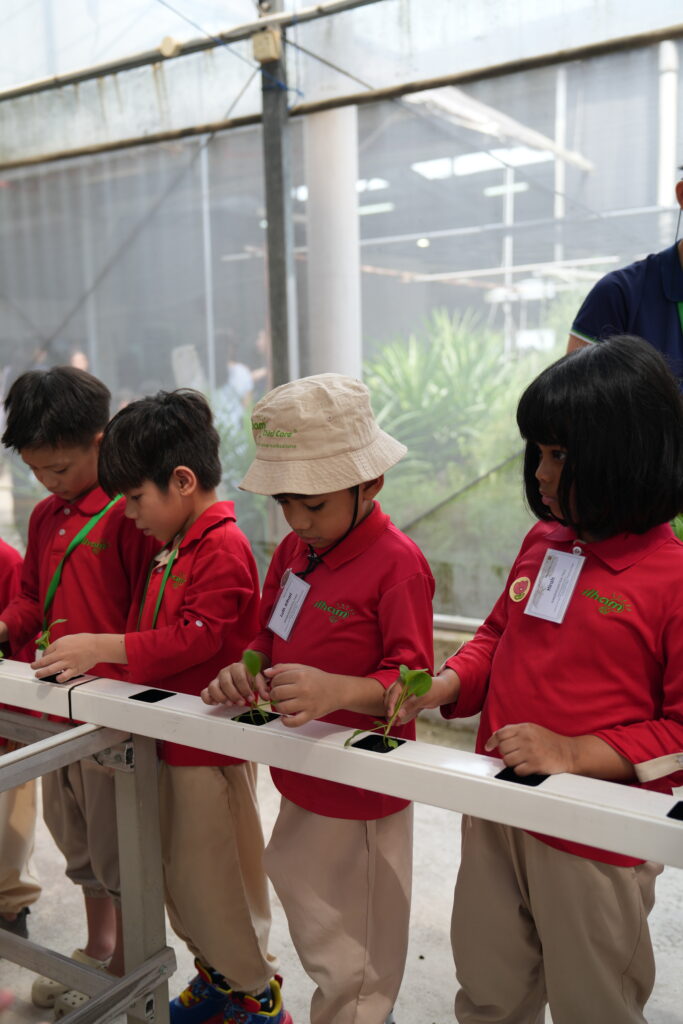
1. How Children Learn to Read and Write
Both Montessori and traditional preschools teach phonics and early literacy — the approach differs. Montessori uses sandpaper letters (tracing letter shapes with fingers) and moveable alphabets to build phonemic awareness through sensorial experience before writing. Traditional preschools typically use structured phonics programmes with worksheets, reading groups, and progressive readers.
Research from the National Institute for Early Education Research found that children from both approaches reach similar reading levels by Primary 2, with Montessori children often showing stronger self-directed reading habits. Neither approach is definitively superior — the quality of implementation matters more than the method.
2. Readiness for Singapore’s Primary School Environment
This is the question Singapore parents ask most. Primary 1 in Singapore is structured, teacher-directed, and moves at a consistent pace across the class. Children need the ability to follow instructions, sit attentively, and work within a schedule.
Research shows Montessori graduates often have stronger executive function — the ability to self-regulate, plan, and focus — which supports them well in P1 and beyond. However, some Montessori children require an adjustment period to adapt to structured classroom routines.
Traditional preschool graduates are typically more accustomed to teacher-directed learning and transitioning between subjects on a schedule — which closely mirrors the P1 experience from day one.
The honest answer: both prepare children well for Primary 1 when the programme is implemented with quality. The adjustment period, if any, is typically brief.
3. Bilingual and Multilingual Language Development
Singapore’s bilingual education policy means language learning is a critical consideration at the preschool level. Children must develop strong proficiency in English and their mother tongue — Mandarin, Malay, or Tamil — from early childhood.
Traditional preschools aligned with MOE’s KCF have structured, dedicated language blocks for English and Mother Tongue. Montessori programmes vary significantly — some fully integrate bilingual learning, while others require parents to supplement mother tongue development outside school.
If Arabic language exposure is also a priority — as it is for many Muslim families in Singapore — a specialised Islamic preschool may offer this as a structured third language, which neither standard Montessori nor typical traditional programmes include.
| 🕌 Ilham’s Multi-Language Approach |
| At Ilham Childcare, children develop proficiency in English, Malay, and receive structured Arabic and Quran exposure through our Ukhrawi programme. |
| This holistic language foundation is rare in Singapore’s preschool landscape. → /islamic-childcare-singapore/ |
4. The Role of Play in Learning
Both Montessori and well-implemented traditional programmes use play as a learning vehicle — they just define ‘play’ differently. Montessori sees purposeful, self-directed work with materials as the highest form of play. Traditional programmes use structured play activities, dramatic play corners, and guided discovery as deliberate curriculum elements.
Singapore’s ECDA and MOE emphasise play-based learning across all licensed preschools through the Nurturing Early Learners (NEL) framework. This means even traditional preschools in Singapore are formally required to incorporate play-based learning — the distinction between Montessori and traditional is less dramatic in practice than in theory.
| 📖 Related Reading |
| Play-Based Learning vs Academic Preschools: What Research Says |
5. Cost and Accessibility in Singapore
Cost is a practical reality for Singapore families. Montessori preschools in Singapore typically charge S$1,500 to S$3,000 per month for full-day programmes, with many private Montessori centres not accepting the Child Development Account (CDA) or ECDA subsidies. This makes them inaccessible to many families without significant disposable income.
ECDA-registered and MOE-licensed traditional preschools are eligible for government subsidies including the Anchor Operator (AO) and Partner Operator (PO) subsidy frameworks, making quality early childhood education substantially more affordable for most Singapore families.
What Does Research Actually Say About Montessori vs Traditional Preschool?
A 2017 landmark study published in Frontiers in Psychology compared Montessori and traditional preschool outcomes across 141 children over three years. The findings showed Montessori children outperformed peers in:
- Executive function and self-regulation
- Reading and maths skills at age 6
- Social understanding and the ability to respond to others’ emotional states
- Sense of school community and enjoyment of learning
However, a 2006 study in Science by Angeline Lillard and Nicole Else-Quest found similar academic outcomes between Montessori and traditional preschool students by the end of primary school, with the Montessori advantage being most pronounced in the early years.
The takeaway for Singapore parents: research generally supports Montessori’s benefits for executive function and intrinsic motivation. But context matters enormously. A high-quality traditional preschool with strong teachers, play-based elements, and genuine attention to individual children will produce outcomes comparable to — and sometimes surpassing — a poorly implemented Montessori programme.
The quality of the teachers and the environment matters more than the label on the school’s door.
How to Choose the Right Preschool for Your Child: A Practical Framework
| Your Child’s Profile | Consider |
|---|---|
| Self-directed, independent learner | Montessori environment may thrive |
| Needs structure and routine | Traditional programme provides clear scaffolding |
| Advanced for age academically | Either approach — ensure challenge level is right |
| Needs extra support or scaffolding | Traditional structured support may be clearer |
| Highly social, thrives with peers | Mixed-age Montessori or rich play-based traditional |
| Religious values are central (Muslim family) | Islamic preschool with either Montessori or holistic traditional |
| Budget is a key consideration | ECDA-registered traditional preschool with subsidies |
Beyond your child’s individual profile, ask these questions when visiting any preschool in Singapore:
- How do teachers respond when a child is frustrated or disengaged?
- What is the teacher-to-child ratio, and how consistent is the teaching team?
- How are language development (English and Mother Tongue) approached formally?
- What does a typical day look like, and how much child-directed time is included?
- How does the centre communicate with parents, and how frequently?
- Is the programme ECDA-licensed, and does it qualify for government subsidies?
- What values underpin the curriculum — and do they align with your family’s?
Ilham’s Holistic Approach: The Best of Both Worlds
At Ilham Childcare, we do not prescribe to a single methodology label. Our curriculum draws on the strengths of both Montessori-inspired and structured traditional approaches, unified by an Islamic values framework and a genuine commitment to holistic child development.
What this means in practice:
- Child-centred learning: We honour each child’s developmental pace and interests, using play as the primary vehicle for early learning.
- Structured language development: Dedicated blocks for English, Malay, and Arabic — with Quran exposure through our Ukhrawi programme — ensure all children build strong multilingual foundations.
- Academic readiness without pressure: Our kindergarten programme builds literacy and numeracy progressively, ensuring children are prepared and confident for Primary 1.
- Islamic values integration: Moral development, character, and aqidah are woven into daily routines — not treated as a separate subject.
- Small class sizes: Our low teacher-to-child ratios mean every child receives genuine individual attention within a warm, family-centred environment.
| 🏆 APAC Best Holistic Childcare Provider 2024 |
| Ilham Childcare was recognised as the APAC Best Holistic Childcare Provider in 2024 — a reflection of our commitment to balanced, high-quality early childhood education. |
| Discover what makes Ilham different |
Frequently Asked Questions: Montessori vs Traditional Preschool Singapore
Q: Is Montessori preschool better than traditional in Singapore?
A: Neither is universally better. Montessori programmes excel in fostering independence, executive function, and intrinsic motivation. Traditional programmes often provide stronger structured academic readiness and are more accessible with government subsidies. The best choice depends on your child’s temperament, your family’s values, and the quality of the specific centre.
Q: Do Montessori children struggle in Singapore primary schools?
A: Research does not support the idea that Montessori children struggle in primary school. Many studies show Montessori graduates adapt well to structured environments and often outperform peers in self-regulation — a critical skill for primary school success. Any initial adjustment to structured routines is typically brief.
Q: Are Montessori preschools in Singapore eligible for ECDA subsidies?
A: Most private Montessori preschools in Singapore are not Anchor Operator (AO) or Partner Operator (PO) centres, so they do not qualify for the main ECDA subsidy tiers. Some may accept Child Development Account (CDA) funds. Always verify subsidy eligibility directly with the centre and check the ECDA directory.
Q: What is the Montessori method in simple terms?
A: The Montessori method is an educational approach where children direct their own learning in a carefully prepared environment with specialised materials. Teachers observe and guide rather than instruct. Mixed-age classes allow children to learn from peers. Independence, concentration, and intrinsic motivation are the primary goals.
Q: How is Ilham Childcare different from a Montessori preschool?
A: Ilham takes a holistic approach that blends child-centred, play-based learning with structured language development and Islamic values education. We are not a Montessori centre, but we share Montessori’s respect for the individual child’s developmental pace. Our key differentiator is the integration of Islamic values, multilingual learning (English, Malay, Arabic), and Quran exposure into every aspect of our programme.
The Bottom Line: Choose the Environment, Not the Label
The Montessori vs traditional preschool debate often generates more heat than light. Both approaches, when implemented well, produce curious, capable, socially confident children. The differences in long-term academic outcomes are far less significant than early childhood advocates on either side suggest.
What matters most is this: a preschool where your child feels safe, seen, and genuinely engaged in learning every day. One where teachers know your child’s name, interests, and challenges. One where your family’s values — whether they include religious education, specific language priorities, or a particular developmental philosophy — are respected and integrated. If you are a Muslim family in Singapore seeking a preschool that honours Islamic values while delivering high-quality holistic early education, Ilham Childcare offers a uniquely positioned programme that no standard Montessori or traditional preschool can replicate
| 📋 Next Steps for Parents |
| Explore our full range of programmes |
| Learn about Ilham’s Islamic and holistic approach |
| View our fees and government subsidy options. |
| Register for our next Open House |